

Emotional regulation is a child’s ability to notice what they are feeling, understand what triggered it and choose how to respond. It is not about never getting angry, sad or frustrated. It is about having enough control to feel those things without the feeling taking over.
The good news is that it can be taught. Children learn emotional regulation the same way they learn to ride a bike: by watching someone do it, practising in small steps and being supported when they wobble. The five techniques below are the ones I come back to again and again with parents, and they work at any age from four upwards.
None of them needs special equipment or a perfect parent. They need patience, practice and persistence.
Why emotional regulation matters so much
A child who can manage their feelings finds almost everything in life easier. They cope better with a disappointing result, a falling out in the playground or a new teacher. They make friends more easily because other children know where they stand with them. They also concentrate better, because a mind that is flooded with worry or anger has very little space left for learning.
When a child cannot yet regulate, the feeling comes out as behaviour: shouting, hitting, slamming doors, refusing to move or melting down in the supermarket. It helps to remember that this behaviour is a signal, not a character flaw. Your job is to help them build the skills so that, over time, they need the meltdown less.
1. Model it yourself first
Children watch far more than they listen. If they see you shout when you are stressed, they learn that shouting is what stress looks like. If they see you pause, take a breath and say how you feel, they learn that instead.
Next time you feel your temper rising, narrate it out loud in a calm voice:
- “I’m feeling really frustrated because we’re late. I’m going to take a deep breath.”
- Step back physically for a moment if you need to.
- Then say what you will do: “Right, let’s find your shoes together.”
You will not get it right every time, and that is fine. When you do lose your cool, coming back and saying “I shouted earlier and I shouldn’t have. I was stressed, and I’m sorry” is one of the most powerful lessons you can give.
2. Build simple mindfulness into the day
Mindfulness sounds grand, but for children it simply means paying attention to what is happening right now, in their body and around them. A few minutes a day is plenty.
- Breathing: try “smell the flower, blow out the candle”, breathing in slowly through the nose and out through the mouth. Do it together at calm times so it is ready to use at difficult ones.
- Mindful colouring or drawing: a quiet, absorbing activity helps a busy mind settle.
- Mindful movement: slow stretches, a short walk where you notice five things you can see and hear, or holding a balance pose.
In our programmes every session includes moments of stillness and focused breathing. Children who practise this regularly find it much easier to reach for when they are upset.
3. Make it safe to express emotions
Children need to know that their feelings are allowed, even the big, messy ones. If every tear is met with “stop crying” or every angry outburst with a lecture, they learn to hide feelings rather than manage them.
When your child is upset:
- Listen first. Get down to their level and let them talk without jumping in to fix it.
- Validate the feeling. “That sounds really disappointing” or “I can see you’re cross” tells them you understand.
- Teach “I feel…” statements. Help them put it into words: “I feel angry because he took my turn.” Naming a feeling takes some of its power away.
Validating a feeling is not the same as agreeing with the behaviour. You can understand why they are furious and still not accept them throwing a toy.
4. Give them a toolkit of coping strategies
Once a child can name a feeling, they need something to do with it. Every child is different, so offer a range of options and notice which ones work for yours.
- Slow breathing, counting to ten or squeezing and releasing their fists.
- Physical activity: running in the garden, jumping on the spot or a few punches on a cushion.
- Time outdoors, which settles many children faster than anything else.
- A favourite hobby, such as building, reading or music.
- Creative outlets like drawing how they feel, writing it down or making up a story about it.
Some parents make a “calm down card” with three or four of their child’s best strategies on it. When emotions run high, they simply point to the card rather than trying to reason with a child who is not ready to listen.
5. Hold clear boundaries while supporting the feeling
Emotional regulation does not mean anything goes. Children actually feel safer when they know where the lines are. The key is to separate the feeling from the behaviour.
A simple formula is: acknowledge, set the limit, offer an alternative. “You’re really angry that screen time is over. It’s not okay to hit your sister. You can stamp your feet or go and punch your pillow.” Then follow through calmly and consistently, every time.
Consistency matters more than strictness. If a boundary holds on Monday but disappears on Tuesday, children quickly learn that a bigger reaction might change the outcome.
How martial arts helps with emotional regulation
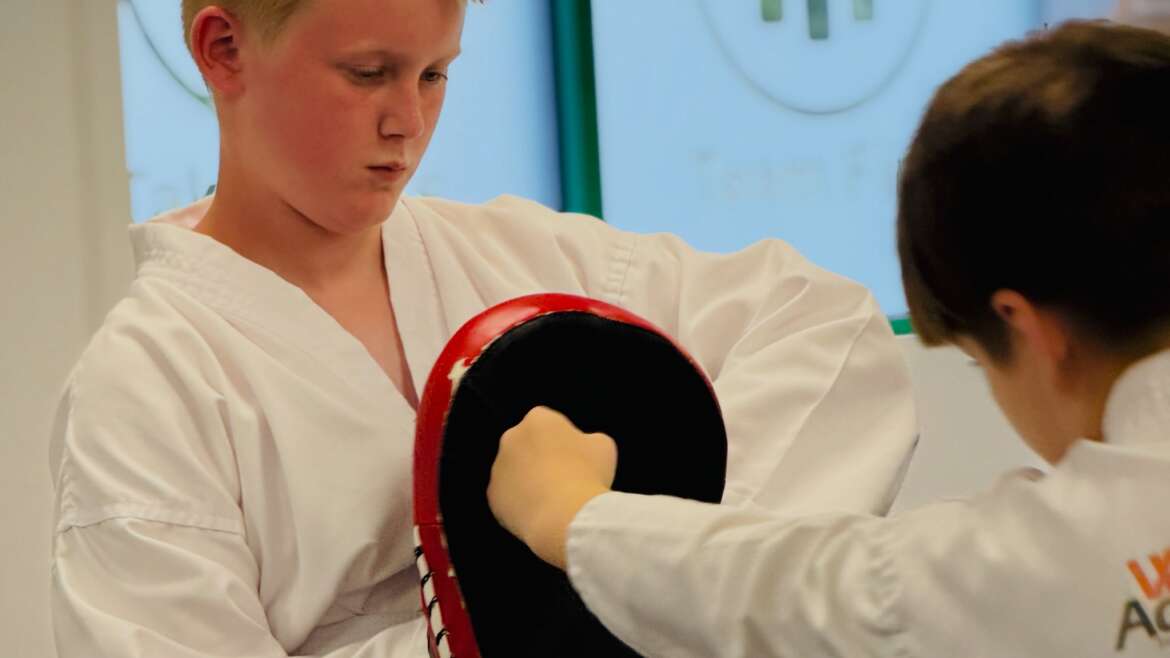
Martial arts is one of the best training grounds for emotional regulation I know. In every session children practise staying calm under a little bit of pressure: holding a stance when their legs are tired, waiting their turn, controlling their power when they work with a partner and listening carefully to an instructor. They learn that they can feel frustrated and still make a good choice.
Our programmes are built around the three Cs: confidence, conduct and concentration. Conduct is exactly this skill, learning self-control and respect so that big feelings do not take charge. Working towards a grading and earning their next coloured belt also teaches children to keep going when something is hard, rather than giving up in a temper.
If you would like to see it for yourself, we run programmes for children aged four and up at our Character Development Centre in Salisbury and Amesbury, at Corsham, for families in Chippenham, and at Motcombe, near Shaftesbury and Gillingham. You can book a free taster session and watch how your child responds.
Key takeaways
- Emotional regulation is a skill, and children learn it through watching, practising and being supported.
- Model calm yourself, and repair openly when you get it wrong.
- Make feelings safe to talk about, and help your child name them with “I feel…” statements.
- Build a personal toolkit of coping strategies, because what works differs from child to child.
- Hold the boundary on behaviour while supporting the feeling behind it, calmly and consistently.
Find your nearest club
Martial arts and character development programmes for children aged 4 and up, across Wiltshire, Somerset, Bath and North Dorset.
Try a free taster
See how The Warrior Academy builds confidence, focus and respect in children aged 4 and up, at our Salisbury centre and clubs across Wiltshire, Somerset, Bath and North Dorset.
Book a free tasterMore from the blog