

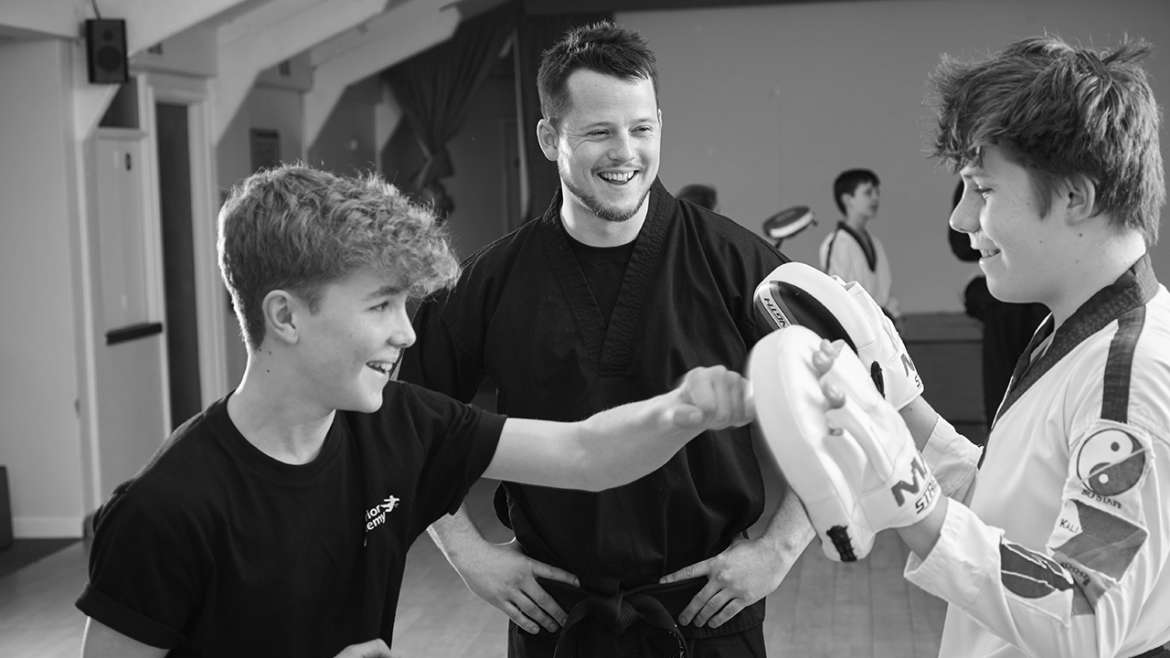
When parents tell me what they want for their children, leadership comes up again and again. They rarely mean the loudest child in the room. They mean the quieter kind of leader: the child who speaks up when something is wrong, who helps the new starter feel welcome, and who does the right thing when nobody is watching.
I was bullied as a child, and I built The Warrior Academy from a village hall in Rode, Somerset, because I wanted children to grow the confidence I did not have at their age. Since 2011 we have watched shy four year olds grow into teenagers who lead the warm-up in front of the whole dojo. This article brings together what we have learned about how leadership skills develop in young people, and what you can do at home to help.
What leadership really means for a child
For a child, leadership is not a title or a badge. It is a set of everyday skills that grow slowly, with practice and the right encouragement. When we talk about leadership at The Warrior Academy, we mean:
- Confidence: being able to stand up straight, make eye contact and speak with a clear voice.
- Responsibility: owning your actions, your kit and your effort, without being chased.
- Empathy: noticing when someone else is struggling and choosing to help.
- Self-control: staying calm under pressure so others can stay calm too.
- Example: doing the right thing first, so others have something to follow.
These skills sit right on top of our three Cs: confidence, conduct and concentration. A child who has those three in place is already most of the way to being a good leader.
How the dojo builds leadership, step by step
Martial arts is a natural place to practise leadership because the structure is clear, everyone can see progress, and older or more experienced students are always working alongside newer ones. Here is how it happens on the mat.
Leading the warm-up
One of the first leadership jobs a student is given is counting or leading part of the warm-up. It sounds small, but standing at the front, projecting your voice and keeping a group in time takes real courage. The first attempt is often quiet. By the tenth, most children are counting loudly and correcting their own pace. That is confidence being built in front of you.
Helping younger students
As children move up the belts, we pair them with newer or younger students to help with a stance, a kick or a pattern. Teaching something is one of the best ways to understand it, and it also teaches patience. A child who has to slow down and explain a front kick to a four year old learns very quickly that leadership is about the other person, not about showing off.
Responsibility that grows with every belt
Children earn coloured belts through gradings, all the way to black belt. With each new belt comes a little more expectation. Higher grades are asked to line up first, set the standard for behaviour and look after the dojo. Students know that a higher belt is not just a reward for good technique. It is a sign that they can be trusted with more.
Speaking up with a strong voice
We ask every student to answer clearly, introduce themselves properly and use a strong voice when they kiai. Over time this carries into school, where speaking up in front of others, asking a question or saying no to something unkind becomes far easier.
Leading by example
The most powerful leadership lesson in any dojo is the one nobody says out loud. Children watch how instructors and senior students behave: how they bow, how they treat a partner who makes a mistake, how they react when they lose a sparring round. We expect our senior students to lead by example, and the younger ones notice.
Leadership at different ages
Leadership looks different at four than it does at fourteen. It helps to know what is realistic.
Ages 4 to 6
At this age, leadership means following instructions well, taking turns and helping a friend. Being chosen to demonstrate a move or hand out pads is a big moment. Praise the effort and the behaviour, not just the result.
Ages 7 to 10
Children in this range can start leading short parts of a session, helping newer students and setting a good example in line. They begin to understand that their behaviour affects the group. This is a great age to give them small, real responsibilities at home too.
Ages 11 and up
Teenagers can lead warm-ups, coach younger students and take on a genuine role in the dojo. They are also at the age where peer pressure is strongest, so the habit of making their own good decisions, and helping friends do the same, matters more than ever.
How parents can encourage leadership at home
What happens in the dojo works best when it is backed up at home. You do not need a special programme. You need a few consistent habits.
- Give real jobs: feeding a pet, setting the table or packing their own kit bag. Real jobs build real responsibility.
- Let them make decisions: offer two sensible choices and let your child decide, then live with the outcome.
- Ask for their opinion: at dinner, ask what they would do in a situation. It shows their voice matters.
- Let them teach you: ask your child to show you what they learned in their session. Teaching builds confidence and memory.
- Praise character, not just results: notice when they helped a sibling, owned up to a mistake or kept going when it was hard.
- Resist rescuing: if they forget their water bottle, let them feel it. Small consequences teach more than reminders.
- Model it yourself: children copy what we do far more than what we say.
Our competitions, Summer Samurai and Winter Warrior, and our Advanced Training Days are also great chances for children to step up, support teammates and handle pressure. You can find out more on our events and competitions page.
Finding the right programme for your child
Every child is different. Some are natural speakers who need to learn to listen. Others are quiet and thoughtful and just need a safe place to find their voice. Our programmes are small and personal, so instructors get to know each student and give them leadership chances at the right pace.
We run clubs across the region, including our Character Development Centre at Salisbury, our club in Corsham near Chippenham, and Motcombe for families in Shaftesbury and Gillingham. The best way to see whether it is right for your child is to come and try it. Book a free taster and see the difference for yourself.
Key takeaways
- Leadership in children is built from confidence, responsibility, empathy, self-control and example.
- Leading warm-ups and helping younger students turns these skills into daily practice.
- Each new belt brings more trust and more responsibility in the dojo.
- Expectations should match your child’s age, from taking turns at four to coaching others as a teen.
- Real jobs, real choices and praise for character at home make the biggest difference.
Find your nearest club
Martial arts and character development programmes for children aged 4 and up, across Wiltshire, Somerset, Bath and North Dorset.
Try a free taster
See how The Warrior Academy builds confidence, focus and respect in children aged 4 and up, at our Salisbury centre and clubs across Wiltshire, Somerset, Bath and North Dorset.
Book a free tasterMore from the blog