

You can improve your child’s concentration by treating it like a muscle: something that gets stronger with regular, well judged practice. Remove distractions, work in short focused bursts with breaks, give one instruction at a time and make sure the basics of sleep, food and movement are in place.
Children are not born with a fixed amount of focus. A child who cannot sit still for homework today can, with the right habits and a bit of patience, build up to much longer stretches. The key is to start where they are and stretch them a little at a time.
Below are the practical steps that make the biggest difference.
Remove distractions first
Concentration is hard for anyone when there is a screen flashing in the corner of the room. Before you ask your child to focus, set the scene.
- Put phones, tablets and the TV remote out of sight, not just switched off.
- Clear the table so only what they need is in front of them.
- Keep noise down, and agree with siblings that this is quiet time.
- Use the same spot for homework or reading each day, so their brain links it with focus.
Even out of sight matters. A device sitting face down on the table still pulls at a child’s attention.
Use short, focused bursts with breaks
Asking a young child to concentrate for an hour straight is setting them up to fail. Instead, work in short bursts that match their age and current ability, then give a proper break.
For a younger child, that might be five to ten minutes of reading or writing, followed by a few minutes of moving around. For an older child, it might be twenty minutes of homework, then a short break. A kitchen timer helps, because the child knows the end is in sight and can give the task their full effort.
Gradually lengthen the focused time as they get better at it, in the same way you would add a little more weight in the gym.
Give one instruction at a time
“Go upstairs, brush your teeth, put your pyjamas on, find your reading book and tidy your bedroom” is five instructions. Many children will remember the first and the last, and lose the rest.
To build listening and concentration:
- Get their attention first: say their name and wait for eye contact.
- Give one clear instruction.
- Ask them to repeat it back to you.
- Praise them when it is done, then give the next one.
As they improve, try two instructions at once, then three. You are training their working memory as well as their focus.
Build routines and look after the basics
A tired, hungry or restless child will struggle to concentrate, no matter how good the strategy. Check the foundations:
- Sleep: a regular bedtime and a calm, screen free wind down make a huge difference to focus the next day.
- Food: a proper breakfast and steady snacks avoid the energy crashes that come with sugary foods.
- Water: even mild dehydration can make children sluggish and distracted.
- Movement: children concentrate better after physical activity, so a run around before homework often helps more than it hinders.
- Routine: doing the same things at the same times each day frees up mental energy for the task itself.
Play games that train focus
Concentration practice does not have to feel like work. Plenty of everyday games build it naturally:
- Simon says: brilliant for listening carefully and controlling impulses.
- Memory pairs: turning over cards to find matches trains attention and recall.
- Jigsaws and building sets: great for sustained, quiet focus.
- Spot the difference and puzzle books: train careful attention to detail.
- Musical statues: children have to listen closely and freeze with control.
Praise sustained effort
When your child sticks with something, notice it out loud. “You concentrated on that puzzle for ages, and you didn’t give up when it got tricky.” Specific praise for focus and effort, rather than for being clever, encourages them to keep pushing their attention a little further each time.
Be patient on the bad days. Concentration naturally dips when children are unwell, worried or overtired. One difficult afternoon does not undo the progress.
How martial arts helps with concentration
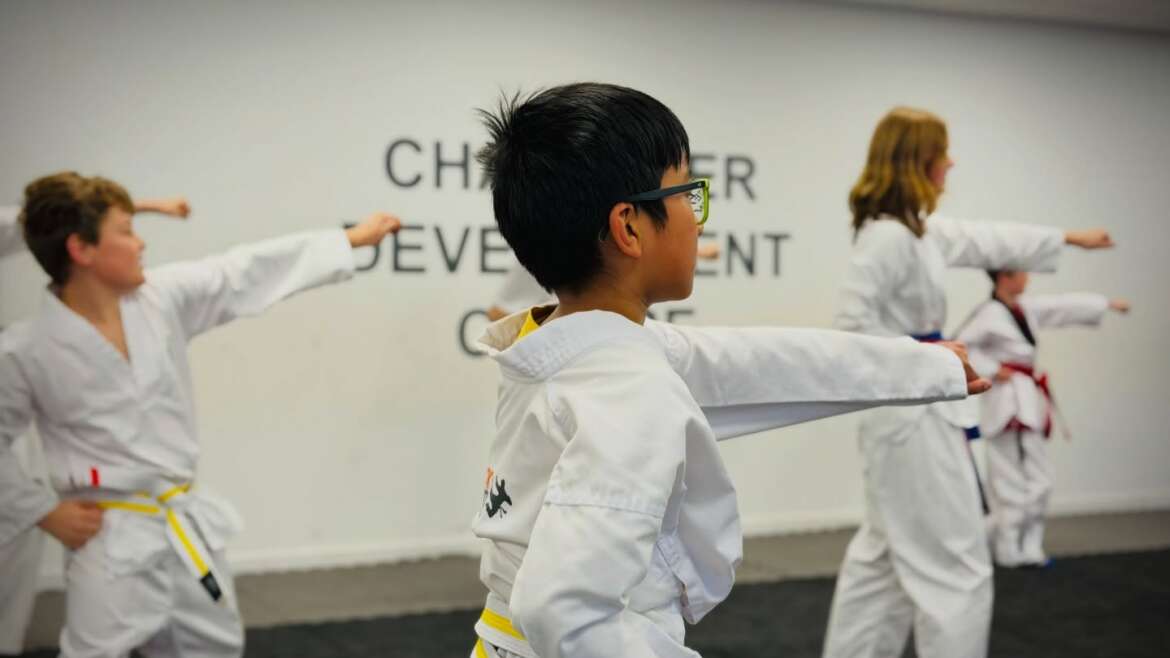
Concentration is one of our three Cs, alongside confidence and conduct, and it is built into every part of a session. Children learn to stand still and listen to their instructor, to watch a technique closely and then copy it, and to remember a sequence of moves in the right order. Instructions start simple and become more detailed as they progress, which stretches their focus step by step.
Every belt has clear requirements, so children know exactly what they are working towards for their next grading. That goal gives them a real reason to practise focus, and many parents notice the change at school and at home. Focus drills, such as reacting only to a particular command, are also great fun, which keeps children engaged.
We run programmes for children aged four and up at our Character Development Centre in Salisbury and Amesbury, at Motcombe, serving Shaftesbury and Gillingham, and at Corsham, near Chippenham. You can book a free taster session and see how your child gets on.
When to get extra support
All children lose focus sometimes. If your child’s concentration difficulties are severe and constant, showing up at home, at school and in activities, and are affecting their learning or friendships, speak to their school and your GP. They can help you understand what is going on and whether any further assessment would be useful.
Key takeaways
- Concentration is a skill that gets stronger with regular practice.
- Remove distractions, especially screens, and use short focused bursts with breaks.
- Give one instruction at a time and ask your child to repeat it back.
- Look after sleep, food, water, movement and routine.
- Praise sustained effort, and speak to the school or GP if difficulties are severe and constant.
Find your nearest club
Martial arts and character development programmes for children aged 4 and up, across Wiltshire, Somerset, Bath and North Dorset.
Try a free taster
See how The Warrior Academy builds confidence, focus and respect in children aged 4 and up, at our Salisbury centre and clubs across Wiltshire, Somerset, Bath and North Dorset.
Book a free tasterMore from the blog