

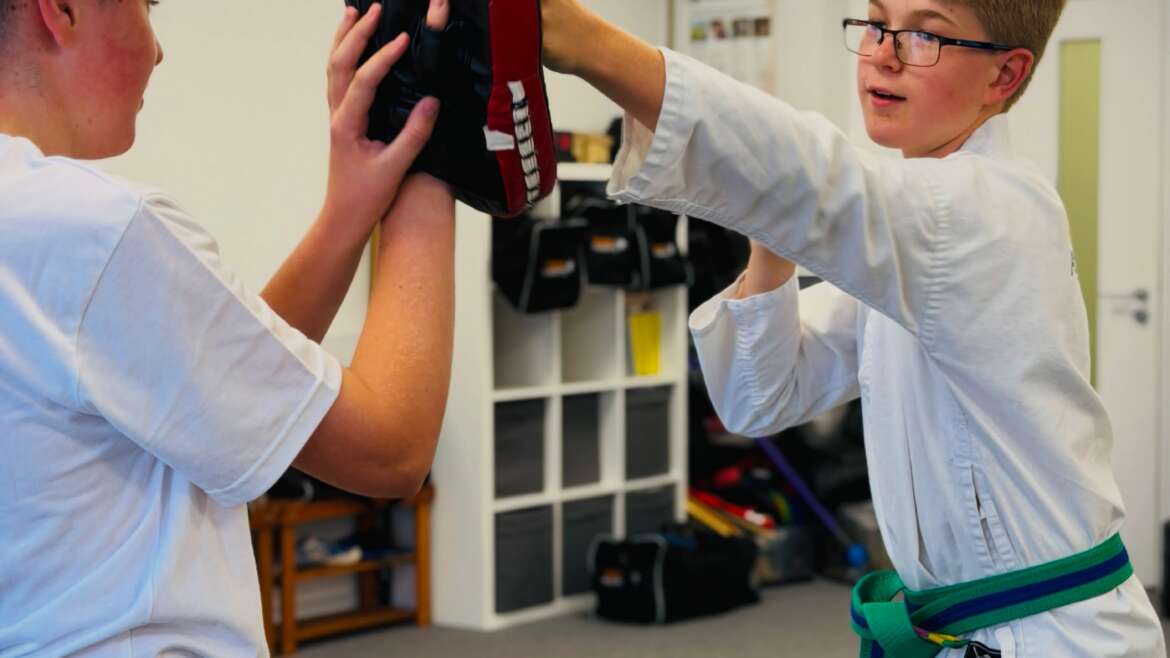
Martial arts is so good at developing character because it gives children structured, repeated challenge against clear standards, with respect and self-control built into every session. Children do not just hear about good values. They practise them, week after week, under the eye of mentors who hold them to a high standard.
Many activities build skill. Fewer build character on purpose. The difference with a good martial arts programme is that behaviour, effort and attitude are part of what is taught and assessed, not a side effect. A child cannot earn their next belt on talent alone.
Here are the reasons I believe it works, from years of watching children change in our programmes.
Structured, repeated challenge with clear standards
Character grows when children face something hard, keep going and succeed. Martial arts creates that experience over and over again. Every session has a clear standard to aim for: a stance held properly, a pattern remembered, a technique done with control. Children know exactly what good looks like, and they know when they have reached it.
Because the challenge repeats, children learn something deeper than any single technique. They learn that practice works, that frustration passes and that their own effort is what moves them forward. That is the root of perseverance.
Belts as visible milestones
The belt system turns progress into something a child can see and feel. Each coloured belt is earned through a grading, and each one represents weeks of steady work. This matters for character because it teaches children to set a goal, break it into small steps and stick with it.
- Goals are clear and achievable, so children experience success regularly.
- Progress is visible, which keeps motivation high through the harder weeks.
- Gradings include attitude and behaviour, not just physical skill.
Respect rituals and self-control under pressure
Bowing at the start and end of a session, bowing to a partner and addressing instructors properly might look like tradition, but they do a real job. These small rituals make respect a habit. Children practise it dozens of times in every session until it becomes how they naturally behave.
Sparring adds something few other activities offer: self-control under pressure. There are clear rules, and children must stay calm, use controlled contact and look after their partner even when they are tired or excited. Learning to manage strong feelings in that moment is exactly the skill they need in the playground, in a sibling argument or when someone tries to wind them up.
Mentors, role models and leadership
Children become who they spend time with. In a good club they spend time with instructors who model calm, firm, kind behaviour, and with older students who show what is possible. Those role models make the values real.
As children progress, they get chances to lead. They might demonstrate a technique, help a younger student who is struggling or lead part of a warm up. Being trusted with responsibility changes how a child sees themselves. A child who helps a nervous four year old find their feet quickly learns patience, empathy and leadership.
Confidence that is earned, not given
There is a difference between being told you are brilliant and knowing you have done something hard. Martial arts builds the second kind of confidence. Praise is specific and linked to real effort, and children earn each step for themselves. That earned confidence is far more robust when things get difficult.
The difference from activities that only reward winning
Plenty of children’s activities are excellent, but some measure success only by results: the goal scored, the race won, the trophy lifted. In that environment, children who are not naturally gifted can feel they are failing, and children who are gifted can learn that winning matters more than how they behave.
A character focused martial arts programme measures something different. A child is recognised for effort, focus and respect, whatever their natural ability. Competitions exist, and can be brilliant, but they are one part of the journey rather than the whole point. Every child has a path to progress, and every child is expected to behave well along the way.
How martial arts develops character at The Warrior Academy
I was bullied as a child, and martial arts gave me the self-belief I was missing. When I started The Warrior Academy in Rode, Somerset, I wanted to build that on purpose for every child. Our programmes for children aged 4 and up are built around the three Cs: confidence, conduct and concentration. Every session, every grading and every competition, including our Summer Samurai and Winter Warrior events, is designed to grow those three things.
You can see it in action in Rode, for Frome and Trowbridge, in Corsham, near Chippenham, or at Monkton Prep School in Bath. The easiest way to understand it is to watch your child try it, so book a free taster and see how they respond.
How to support character growth at home
What children learn in training sticks best when it is reinforced at home.
- Use the same language. Ask, “Where did you show confidence today?” or “How was your focus?”
- Praise effort and behaviour, not only results.
- Give them small responsibilities at home that match what they are trusted with in training.
- Talk about setbacks as part of learning, just like a grading that needs another go.
Key takeaways
- Martial arts builds character through structured, repeated challenge with clear standards.
- Belts give children visible milestones that teach goal setting and perseverance.
- Respect rituals and sparring rules make respect and self-control a habit.
- Mentors and leadership opportunities help children grow into role models themselves.
- Confidence is earned, not given, and effort is valued above winning.
Find your nearest club
Martial arts and character development programmes for children aged 4 and up, across Wiltshire, Somerset, Bath and North Dorset.
Try a free taster
See how The Warrior Academy builds confidence, focus and respect in children aged 4 and up, at our Salisbury centre and clubs across Wiltshire, Somerset, Bath and North Dorset.
Book a free tasterMore from the blog