

You build a child’s confidence without pushing too hard by treating it as a set of skills to practise, not a personality trait they either have or don’t. Small, regular stretches, a little harder than last time but never overwhelming, build far more confidence than big leaps or constant pressure.
The confidence worth aiming for is not loud bravado. It is calm confidence: the child who can walk into a new room, speak up when something is wrong and handle a mistake without falling apart. That kind of confidence holds under pressure, and every child can learn it.
In our programmes I work with children who arrive shy, anxious or quick to give up. The ones who change most are not the ones pushed hardest. They are the ones given the right challenge, the right support and plenty of chances to practise.
Confidence is trained, not luck
Many parents assume confidence is something you are born with. Some children are naturally more outgoing, but being outgoing and being confident are not the same thing. A quiet child can be deeply confident, and a loud child can be very unsure of themselves underneath.
Real confidence comes from evidence. Every time a child tries something, copes with it and sees that they managed, they collect a little more proof that they are capable. Your job as a parent is to help them gather that proof, one small win at a time.
Why praise alone doesn’t work, and overprotection makes it worse
Telling a child they are brilliant feels supportive, but praise on its own does not build confidence. Children know when they haven’t actually done anything, and empty praise can make them more anxious about living up to it.
Overprotection is the quieter problem. When we step in every time something looks difficult, rescue them from every awkward moment or answer for them when an adult asks a question, we send a clear message: “I don’t think you can handle this.” Children believe us, and they stop trying.
The answer is not to step back completely. It is to stay close, offer support and then let them do the hard part themselves.
Six confidence skills to practise every day
These are simple enough to practise at home, on the school run or at the dinner table.
1. Posture and eye contact
How a child stands changes how they feel and how others treat them. Practise standing tall with shoulders back, head up and eyes on the person they are speaking to. Make it a game: who can hold eye contact while saying hello to the neighbour?
2. A clear, steady voice
Mumbling invites people to talk over you. Encourage your child to speak a little slower and a little louder. Let them order their own food, ask the shop assistant a question or answer the phone. Each one is a small rehearsal.
3. Handling mistakes
Teach a simple routine for when things go wrong: stop, take a breath, say “that’s OK, I’ll try again” and have another go. Model it yourself when you spill the milk or take a wrong turn.
4. Trying something hard each week
Agree one small stretch a week together. It might be joining in at the park, putting a hand up at school or trying a new food. Keep it achievable, then talk about how it went.
5. Calm breathing under pressure
Nerves are normal. What matters is having a way to settle them. Teach slow breathing: in through the nose for a count of four, out through the mouth for a count of four, repeated a few times. Practise when they are calm so it is ready when they need it, before a test, a performance or a tricky conversation.
6. Finishing what they start
Quitting the moment something gets difficult teaches children that hard things are to be avoided. Within reason, encourage them to finish the term, the jigsaw or the book before deciding whether to carry on. The feeling of seeing something through is a huge confidence builder.
How to stretch without pushing too hard
The difference between stretching and pushing is usually about size, choice and support.
- Keep steps small. If your child is frightened of speaking to adults, start with saying thank you to the bus driver, not a speech in assembly.
- Give them some choice. “Would you like to ask for the bill or pay at the till?” lets them stay in control while still stepping up.
- Prepare together. Talk through what will happen and what they might say. Role-play it at home if it helps.
- Stay nearby. Knowing you are close makes it far easier to be brave.
- Praise the effort, not just the outcome. “You felt unsure and you did it anyway” is exactly the message you want them to remember.
- Read the signs. Tears, stomach aches or refusing to leave the car are signs the step was too big. Go back a step, not back to the start.
If anxiety is stopping your child from going to school, sleeping or enjoying everyday life, speak to your GP or your child’s school. Some children need extra support, and that is nothing to be worried about asking for.
What changes when confidence grows
When children build these skills, parents often notice the same things. They stand taller. They react less emotionally when things don’t go their way. They communicate better with teachers, friends and family. And when a setback comes, a lost match or a bad mark, they bounce back faster because they have done hard things before.
How martial arts helps build calm confidence
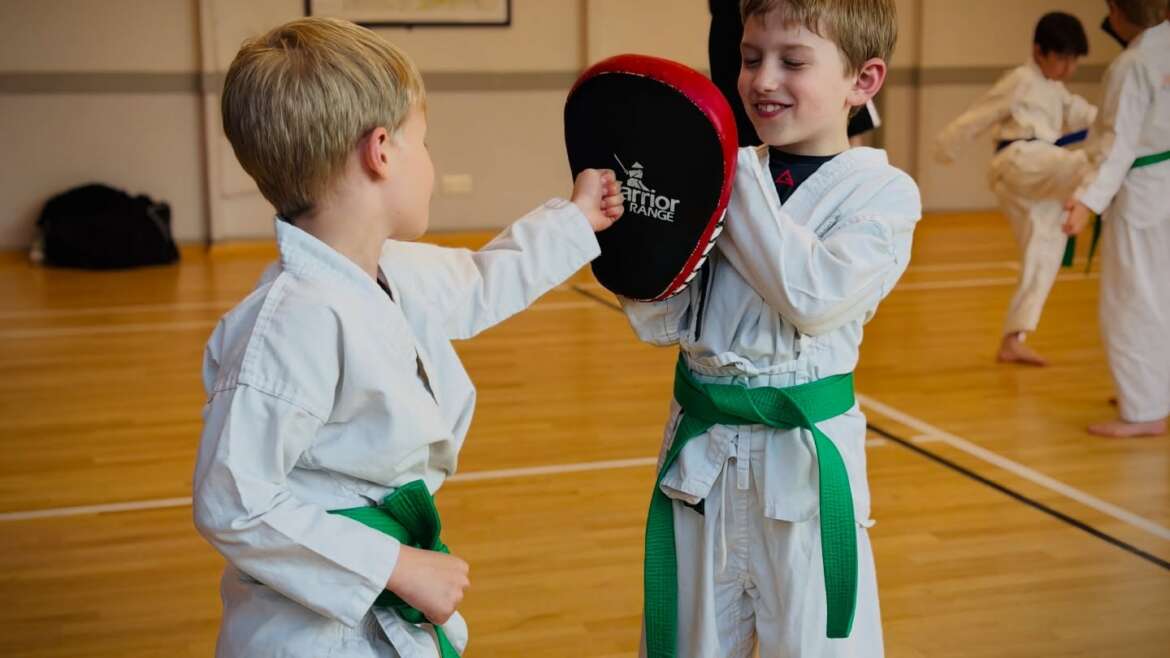
Our martial arts and character development programmes at The Warrior Academy are built around exactly these skills. We focus on the three Cs: confidence, conduct and concentration. Children practise posture, eye contact and a clear voice in every session. They learn to stay calm under pressure, to try again after a mistake and to finish what they start as they work through coloured belt gradings.
Each step is pitched to stretch them without overwhelming them, so they build confidence steadily rather than being thrown in at the deep end. We welcome children aged 4 and up at our club in Bath, at Monkton Prep School in Combe Down, in Freshford, for Bradford on Avon, and in Motcombe, for Shaftesbury and Gillingham. If you would like to see it for yourself, book a free taster session.
Key takeaways
- Confidence is a set of trainable skills, not luck or personality.
- Aim for calm confidence that holds under pressure, not loud bravado.
- Praise alone doesn’t build confidence, and overprotection quietly undermines it.
- Practise small daily skills: posture, voice, handling mistakes, breathing and finishing what they start.
- Stretch in small steps with choice and support, and step back if a challenge is too big.
Find your nearest club
Martial arts and character development programmes for children aged 4 and up, across Wiltshire, Somerset, Bath and North Dorset.
Try a free taster
See how The Warrior Academy builds confidence, focus and respect in children aged 4 and up, at our Salisbury centre and clubs across Wiltshire, Somerset, Bath and North Dorset.
Book a free tasterMore from the blog